Technology
 Hacker NewsAugust 5, 202610 min read
Andrew Marritt Aug 05, 2026 1 Share Ask a room full of people how they got their current job and you will hear a pattern. A former colleague mentioned an opening. A friend of a friend made an introduction. Someone they worked with years ago got in touch. A recruiter found them - which is to say, a professional whose entire job is being a node in other people’s networks found them. A minority will have answered an advertisement cold. In most rooms, it is a small minority.
We have known this formally for fifty years. In 1973 a young sociologist named Mark Granovetter published a paper in the American Journal of Sociology called “The Strength of Weak Ties”. It is, by most counts, among the most cited papers in the whole of social science, and it began with a survey question much like the one above. Granovetter asked professional, technical and managerial workers in a Boston suburb how they had found their jobs. Most of those who found work through a personal contact had found it through someone they saw occasionally or rarely - an acquaintance, a former colleague, a friend from an old chapter of life. Fewer than one in five had found their job through someone they saw often.
That finding, and the theory behind it, opened up a field that most HR practitioners, and I suspect many of my readers from psychology and economics, have never been formally introduced to: economic sociology - the study of how economic life actually runs on social structure. This issue is that introduction. I think you will find, as I did, that it explains things about recruitment that neither psychology nor economics can reach on their own - and that it has now passed one of the largest experiments ever run on a theory in social science.
To see why the sociology matters, start with the model it displaced.
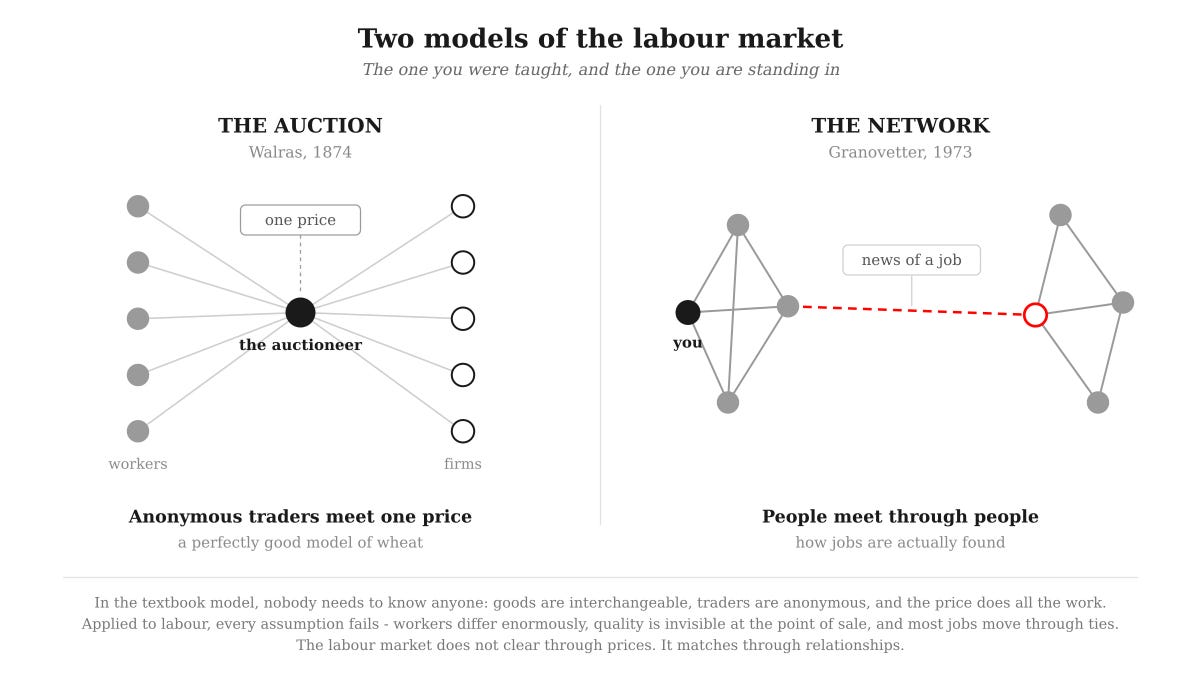
The textbook picture of a market comes from the nineteenth-century economist Léon Walras , and economists still call it the Walrasian auction . Imagine an auctioneer standing between everyone who wants to sell something and everyone who wants to buy it. The auctioneer calls out a price. If more people want to buy than sell, the price rises; if more want to sell than buy, it falls. Eventually a price is found at which supply exactly meets demand, everyone trades, and the market clears . Nobody needs to know anyone. The goods are interchangeable, the buyers and sellers are anonymous, and the only information that matters is the price. If you took an introductory economics course, this is the machinery behind the supply and demand curves you drew: the curves themselves just record willingness to buy and to sell, and the auctioneer’s price adjustment is how the market is assumed to find the point where they cross.
This is a perfectly good model of the market for wheat or copper - homogenous products. Applied to labour, it makes three assumptions, each of which this series has already spent an article dismantling. It assumes workers of a given type are interchangeable - but the productivity differences between people in the same job are enormous, as we saw in Issue 5 . It assumes quality is visible at the point of sale - but every hire is a bet made in the dark, as we saw in Issue 6 . And it assumes that a worker’s value is a fact about the worker - when a large component of productivity is match-specific : the same person is differently productive at different firms, in different teams, under different managers.
Add the plainest fact of all - that most jobs are filled through people rather than through anything resembling an auction - and the textbook model is not simplified so much as wrong in its architecture. The labour market does not clear through prices. It matches through relationships.
What I find striking, and what makes this a very Working Ideas story, is that two disciplines reached this conclusion independently and spent decades barely citing each other. Sociology got there through Granovetter and the study of networks: economic action, he later argued, is embedded in concrete social relations, not conducted between strangers. Economics got there through the study of search and matching - the recognition that when meeting is costly and quality is revealed slowly, the process by which workers and firms find each other matters more than the wage - work recognised in the 2010 Nobel award to Peter Diamond , Dale Mortensen and Christopher Pissarides , and, as we will see later, in the 2012 award to Alvin Roth and Lloyd Shapley for showing that matching processes can be deliberately designed. When two fields that do not read each other abandon the same model, the model deserves to stay abandoned. The Walrasian auction, as a model of the labour market, is that model.
Granovetter’s paper is worth understanding properly, because the reasoning is more interesting than the headline.
The argument has two steps. The first is almost geometric. Your strong ties - close friends, immediate colleagues - tend to know each other. Friendship is roughly transitive: if I am close to two people, the odds are good they are at least acquainted. Strong ties therefore form dense clusters. And that has a structural consequence: any bridge between two clusters is almost always a weak tie. A close friend cannot easily be your only link to a group of people, because closeness would have pulled the rest of your circle into contact with them too.
The second step converts that geometry into information. People who share a cluster share an information environment. Your close friends mostly know what you know - the same openings, the same gossip, the same opportunities. Novel information lives on the other side of the bridges, and the bridges are weak ties. So when Granovetter’s respondents reported finding jobs through acquaintances rather than friends, this was not a curiosity about American suburbs. It was the visible trace of network structure: the people most likely to tell you something you don’t already know are the people you know less well.
I want to underline what kind of explanation this is, because it is the gift sociology brings to this series. Psychology explains outcomes through properties of people - ability, personality, motivation. Economics explains them through incentives and information. Granovetter explains a labour-market outcome through the shape of the connections between people , holding the people and the incentives constant. Nobody in the story behaves differently; the acquaintance is not kinder or better informed as a person. They simply sit somewhere different in the structure, and position does the explaining. Once you have seen this move you start finding uses for it everywhere - and recruitment, as we will see, is full of them.
One clarification the popular version usually mangles: the mechanism is information reach , not favours. The weak tie is not exerting themselves on your behalf. They are simply relaying something your cluster could not see. This matters for practice, because it tells you what a network is for in a job search - coverage, not advocacy - and it sets up the modern evidence, which complicates the story in a satisfying way.
For most of its life the weak-ties finding was correlational. People who found jobs through acquaintances might differ in a hundred unobserved ways from people who didn’t. The claim also acquired a folk version - acquaintances beat friends, so network wide rather than deep - that the data never quite supported.
Two modern studies sharpened things considerably. Laura Gee, Jason Jones and Moira Burke, studying millions of Facebook users in a 2017 paper in the Journal of Labor Economics (with a companion study across 55 countries with Christopher Fariss and James Fowler), found what they called the paradox of weak ties : collectively, most job help does flow through weak ties, exactly as Granovetter said - but only because we each have vastly more of them. Any individual strong tie is more valuable than any individual weak tie. Both statements are true at once. It is a base-rate story, of the kind regular readers will recognise from Issue 7 : the channel with the most total traffic is not the channel with the highest value per contact.
Then came the experiment. LinkedIn’s “People You May Know” algorithm was, for years, being A/B tested - different users were randomly shown different mixes of recommended connections. Karthik Rajkumar, Guillaume Saint-Jacques, Iavor Bojinov, Erik Brynjolfsson and Sinan Aral realised this amounted to a randomised trial of Granovetter’s theory at civilisational scale, and published the result in Science in 2022: twenty million users, five years, two billion new ties, six hundred thousand job changes. Because the algorithm randomly varied whether people formed weak or strong ties, the study could do what fifty years of surveys could not - establish cause.
The theory was validated, with a twist worth remembering. Weak ties do causally increase job mobility. But the relationship is an inverted U: moderately weak ties - roughly, people with whom you share about ten mutual connections - produced the most job movement, not the weakest ties. A contact with no overlap with your world can see openings but can barely vouch for you or judge the fit; a close contact can vouch but sees nothing new. The value peaks where novelty and relationship are both present. The folk advice fails in both directions: it is not depth, and it is not maximal breadth. It is the middle distance - the former colleague, the old classmate, the person one conversation removed.
There is a quietly important postscript. The experiment that confirmed the theory was run by a platform whose recommendation algorithm now shapes the very network the theory describes. The labour market’s wiring is no longer entirely organic; some of it is designed, by parties with their own objectives. Hold that thought - it returns at the end of this series.
So jobs travel through ties. The next question is what, exactly, is being discovered when a match is made - and here the economists take over the story.
In 1979 Boyan Jovanovic published “Job Matching and the Theory of Turnover” in the Journal of Political Economy , formalising an idea that every experienced manager knows in their bones: how well a particular person fits a particular job is not knowable in advance. It is revealed slowly, through performance, after the match is made - an idea I covered in the earlier essay on information in recruitment . Economists would say the match is an experience good - like a restaurant, you learn its quality by consuming it - rather than an inspection good like a bolt of cloth, which you can assess before buying. From that single assumption Jovanovic derived the great empirical regularities of turnover: separations concentrate early in tenure (bad matches reveal themselves and dissolve), and quit rates fall as tenure lengthens (surviving matches are, increasingly, the good ones).
The model has a consequence that inverts a durable piece of recruitment folklore. If match quality can only be discovered by trying, then early-career job changing is not flightiness - it is search, working as it should. Robert Topel and Michael Ward showed this convincingly in a 1992 paper in the Quarterly Journal of Economics : a typical young worker - the data follow young men - holds seven jobs in the first ten years of a career, two-thirds of the jobs he will ever hold, and wage gains at job changes account for at least a third of all early-career wage growth. Each move is a new draw from the match-quality distribution, and the pay rise at the move is the return to a better draw. The “job-hopper” your screening process flags may simply be someone whose search is still converging - and the tenure you prize in later-career candidates is partly the result of good matching, not evidence of a loyal disposition.
How much of match quality can screening actually see in advance? Remarkably, we now have an e
Hacker News
news.ycombinator.com